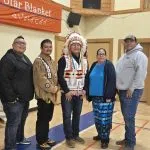
The finish line at Fort Carlton of a 348 km canoe journey (photo: Lloydminster Public School Division)
Treaty 6 Turns 150

Students complete epic 348 km journey to mark 150th anniversary of Treaty 6

Jun 22, 2026 | 4:27 PM

The 348 kilometre canoe trip, winding through lakes and camping on shorelines, wasn’t just set up to retrace a significant part of Saskatchewan history. It was also designed to make a lasting impact on the young canoers.

“It was a once-in-a-lifetime experience,” said Elliot Holden, grade 7 student at E.S. Laird Middle School.

“Even though I’m not an Indigenous person, I felt a very deep understanding and connection to the Indigenous culture.”

A group of students from Lloydminster Public School Division embarked this spring on an eight-day canoe journey to commemorate the 150th anniversary of Treaty 6.

The group flew a Treaty flag for a portion of the journey down the North Saskatchewan River (photo: Lloydminster Public School Division)

“What better way to celebrate and do something that was worthy of this anniversary than paddle from one of the signing sites to another,” said Luke Maw, E.S. Laird principal and organizer of the trip.

“It felt fitting that this would be an incredible act to show our commitment to bridging communities, building relationships, and establishing connections with one another. It was something we could be proud of.”

The journey retraced routes taken by First Nations and Crown representatives during Treaty 6 negotiations and signing in 1876. Each leg of the journey was completed by different school groups: the first leg was completed by Lloydminster Comprehensive High School and Avery Outreach School from Fort Pitt to Paynton Ferry; the second was completed by E.S. Laird Middle School from Paynton Ferry to Glenburn Regional Park; and the third by Bishop Lloyd Middle School and College Park School to Fort Carlton.

“In my experience, canoe trips change people,” said Maw, who is an avid canoe tripper.

“They learned to do hard things, things that were uncomfortable. They learned to support one another through difficult times when they faced adversity.”

E.S. Laird Middle School Principal Luke Maw, an experienced paddler, organized the voyage (photo: Lloydminster Public School Division)

The trip was completed in a 30-foot voyager canoe, allowing the students to complete each leg in one boat. The voyager canoe travels faster than a regular tandem canoe – Maw said they would average around 8 to 14 kilometres an hour, traveling around 50 kilometres total per day.

Maw said that the canoe itself served as a symbol of truth and Reconciliation.

“Every individual in the canoe has a paddle in the water, working together for a common goal. What a fitting metaphor – it doesn’t matter your background or level of experience, everyone is equal in the canoe,” said Maw.

The 348 kilometre trip was not a walk in the park, said Maw. Of the eight days paddling on the water, the canoe faced strong headwinds on all but one day. Additionally, poor weather was not uncommon throughout the trip. But Maw said spirits remained high.

Students cooking on an open fire during the canoe trip (photo: Lloydminster Public School Division)

“When you see those kids on the first day, you see an incredible amount of growth by day three,” said Maw.

The student population at E.S. Laird Middle School is about 25-30 percent Indigenous. Maw said the canoe trip had a diverse mix of Indigenous and non-Indigenous students.

“I think that diversity really left everyone with a rich experience. I think the learning that everyone took away is that we’re all Treaty people and we all share the responsibility in regards to Treaty,” said Maw.

“My challenge to the students was, now that you’ve had this incredible experience, how are you going to know you’re a changed individual?”

Grade 7 student Elliot Holden in mud during the second leg of the voyage (photo: Lloydminster Public School Division)

For Grade 7 student Elliot Holden, the connections he made with Indigenous culture and ceremony made a mark.

“Everyday, before we would depart in the morning, we would spread tobacco for the water spirits for a safe journey down the river,” said Holden. “Every time we saw an animal, we had to spread more tobacco for the animal to think the water spirit for sending the animal to check up on us.”

Holden said spending time, outside, with his classmates, and without technology, was a highlight of the trip. He said he learned something about himself as well.

“I learned that I’m determined,” he said. “I think no matter what your personality is, you’ll find something amazing on a trip like this.”