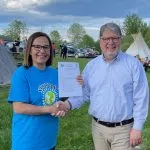
Kawacatoose First Nation welcoming home their ancestor’s tipi (photo: Andrew Miller)
Tipi Repatriation

100 years later, stolen tipi returned to Kawacatoose First Nation

Aug 30, 2026 | 10:38 AM

After a 3,000 kilometre journey, a stolen tipi has been returned to Kawacatoose First Nation.

On Friday August 28, Chief (Okimow) Cory Dustyhorn of Kawacatoose First Nation, drove into his community and delivered a 100 year-old tipi cover, which was being held at the Smithsonian’s National Museum of the American Indian in Washington, DC.

“When we finally got our hands on it, it was amazing. Very emotional. I did shed a few tears,” said Dustyhorn.

“Right away, as soon as I put my hands on it, it felt like a reconnection.”

The long journey to have the stolen tipi returned to Kawacatoose First Nation started two-and-a-half years ago when Andrew Miller, professor of Indigenous Studies at the First Nations University of Canada, began reaching out to the Smithsonian to inquire about the tipi.

The teepee being set up in Kawacatoose for the first time in 100 years (photo: Andrew Miller)

The Smithsonian were very open to it, said Miller, but needed a reconstructed genealogy of the Dustyhorn family to verify that they were in line to receive the tipi cover. Fortunately, Dustyhorn was in possession of an old medallion that had an image of the exact tipi held at the American museum.

“We had to go back and forth with them quite a bit. The process takes a long time,” said Miller. “But we kept at it, kept poking the bear and making sure they don’t forget about us.”

The tipi was taken from the First Nation in 1926 during a celebration of the Treaty 4 signing in Fort Qu’Appelle, where a well-known freelance buyer acquired the tipi and eventually sold it to the Smithsonian.

“These collectors had reputations of inappropriately acquiring items,” said Miller. “First Nations communities were being criminalized for their spirituality, controlled economically, and encouraged by the church and state to divest themselves of anything that stood in the way of them assimilating. It was all very oppressive.”

Five Dustyhorns and Dr Andrew Miller crossing the Canadian border with the successfully repatriated tipi cover (photo: Andrew Miller)

This June, the Smithsonian informed the Kawacatoose leaders that the tipi would be returned to its home community, and that they would financially support the journey for three individuals from the First Nation.

After the news, Chief Dustyhorn received some important council from the Elders in the community.

“It was a long drive. It took us four days to get back. We could have flown,” said Dustyhorn. “But our Elders said ‘go get it by vehicle. Keep it connected to the ground.’ So we listened to our Elders.”

Before reconnecting with the tipi at the museum, the small group that travelled from Kawacatoose smudged and sang ceremonial songs at the facility.

“I didn’t ask for it back for the Dustyhorn family. I asked for it back on behalf of the Kawacatoose First Nation. For my people,” said Dustyhorn. “And they’re waiting. They’re celebrating already.”

Chief Dustyhorn and Senior Repatriation specialist Rachel Shabica conclude the transfer signing of the 100 yr old tipi cover (photo: Andrew Miller)

One hundred years after being taken from their people, Kawacatoose welcomed the tipi home on Friday with a community celebration.

The tipi will be kept in the community for a short while before being temporarily housed at the Royal Saskatchewan Museum in Regina. It will be held there until Kawacatoose opens their own museum, where the tipi will ultimately be held.

“We’re in this new era in Indigenous and museum relations. They’re starting to wake up to the fact that they have this responsibility to give these things back to First Nations,” said Miller.

Figure of man on the tipi holding pipe and sweet grass (photo: Andrew Miller)

Miller said it’s not just about returning a stolen item, it’s about reconnecting with something deeper that was removed.

“I see the impacts of losing something like this. This is a ceremonial items that connects us to ceremony. You lose the item and the next generation doesn’t have the opportunity to learn, to participate, to carry that forward,” said Miller.

“I think people’s sense of identity is returning. This has the potential to give back some of that back, which is why it’s being celebrated. It’s a powerful thing.”