Low water levels in 2025 at Big Stone River, off of Cumberland Lake. Big Stone River is the intake river for the local drinking water reservoir (photo: ISWEWAK)
Lake Diefenbaker Irrigation Project

Concerns over major irrigation project prompt advocates to hold water assembly

Jul 25, 2026 | 11:19 AM

Two water advocates from Cumberland House are voicing major concerns about the Saskatchewan River Delta and the province’s freshwater management.

“Water is life, and if our rivers and lakes are going to dry up, it effects everyone,” said Denise McKenzie, water advocate with the Indigenous Saskatchewan Women’s Environmental Water Advocacy Keepers (ISWEWAK).

“We need to protect the water. We’re desperate – it needs to be done now, not later.”

The Saskatchewan River Delta is the largest freshwater inland delta in North America, covering roughly 10,000 square kilometres across east-central Saskatchewan and west-central Manitoba. It features a complex network of lakes, wetlands, river channels, and low-lying boreal forests.

But decades of disruption from upstream hydroelectric dams, like the E.B Campbell dam, Nipawin dam, and Gardiner dam, have altered water flow and trapped sediment, reducing spring flooding which is crucial for wetland health and local wildlife.

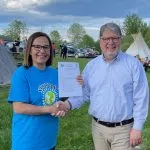
Denise McKenzie and Veronica Favel, water advocates with the Indigenous Saskatchewan Women's Environmental Water Advocacy Keepers (photo: ISWEWAK)

Now, ISWEWAK advocates are sounding the alarm about the future of the Saskatchewan River Delta in response to the Lake Diefenbaker Irrigation Project – a proposed $4 billion multi-decade infrastructure development by the Saskatchewan government aiming to irrigate up to 500,000 acres of farmland.

“It’s not only going to effect the lakes and the delta, but the whole Saskatchewan river system. There won’t be any water between these lakes, especially with how big this irrigation project is. There will be nothing,” said McKenzie.

Veronica Favel, another water advocate with ISWEWAK, said the situation looks dire for much of the province.

“We’re going to dry out,” said Favel. “It’s going to be very devastating. You won’t see water flowing through Saskatoon, you won’t even need the bridges.”

Favel and Mckenzie, both of whom reside in Cumberland House, said that they have seen profoundly significant changes to the lake and environment around them. According to Mckenzie, since the nearest dam was put in, Cumberland Lake was 30 miles (48 kilometres) across, and today is roughly 2 miles (3 kilometres) across.

“The depth used to be 30-40 feet. Now it’s only a few feet. That’s how much we’ve lost since the dam was put in,” said McKenzie. “When it comes to irrigation, we know this will be the end.”

Map of the Saskatchewan River Delta

In response to the Lake Diefenbaker Irrigation Project, ISWEWAK is holding a water movement from August 1-6, each day holding a gathering in a different city or town in Saskatchewan and Manitoba. Their schedule is as follows:

August 1 – OCN, The Pas, Manitoba

August 2 – E.B. Campbell Dam, SK

August 3 – Prince Albert, Stewart Park, SK

August 4 – Saskatoon, Rotary Park, SK

August 5 – Diefenbaker Dam, SK

August 6 – Regina, Legislative Grounds, SK

Dried up lake bed of Cumberland Lake in 2025 (photo: ISWEWAK)

In each location, guest speakers local to that area will share knowledge of water conservation and environmental stewardship. Elders and youth will also share their perspectives.

“It’s about connection and relationships, culturally, with the land and water,” said Favel. “We’re hoping to raise awareness and bring the delta into these different communities.”

Research from the Canadian Parks and Wildness Society (CPAWS) has not only shown altered flow and nutrient depletion as a result of hydroelectric and water management on the delta, but population collapses including muskrats, moose, fish, and waterfowl.

Favel said that these impacts have causes major consequences to local trappers, fishermen, and land users.

“The (response) needs to be Indigenous-led because we know this land. We know how to fix it,” said McKenzie. “We’ve been on this land for thousands of years – we didn’t cause this devastation.”

The Saskatchewan River Delta is also a massive natural carbon sink that stores billions of tonnes of carbon within its ecosystem. The drying out of the wetlands would mean risking massive release of stored carbon.

Favel and McKenzie have been sending letters to both the provincial and federal governments, with little response. They also coordinated a petition which was recently sent to the federal government, but have yet to receive a response.

Big Stone River, with a wood marker showing the receding water levels (photo: ISWEWAK)

“We weren’t getting far with our awareness. We need more voice out there so people know what’s going on,” said McKenzie.

“We want policy change for protection of the Saskatchewan River Delta. From there it’s a chain reaction so that the same water protection that we receive will go to other areas of the Saskatchewan river system, or anywhere.”

This December 8-10, members of the ISWEWAK will be attending the United Nations Water Conference in Abu Dhabi – a conference with goals of driving global political water commitments, financial commitments, and technological innovation for water security.

“We hope we can reach the right ears, like those at the United Nations, who can really make a difference for us here,” said McKenzie.

“We need to do something. We all need to do our part to pressure the decision-makers to protect our water.”

More information on the upcoming Water Movement can be found on the Facebook page: Indigenous Saskatchewan Women’s Environmental Water Advocacy Keepers