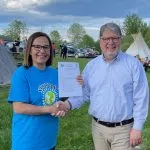
Chief Christine Longjohn cuts the ribbon at the new birthing lodge at Sturgeon Lake First Nation (photo: Tina Pelletier)
Shirley Bighead Nihāwiki

Two new Indigenous-led birthing programs provide new mothers with vital cultural supports

Jun 2, 2026 | 1:54 PM

Spring in Saskatchewan has brought two new traditional Indigenous birth programs.

Sturgeon Lake First Nation celebrated the grand opening of the Shirley Bighead Nihāwiki and Ohpikihāwasowin Birthing and Child Rearing Lodge this spring. The Lodge provides mothers from the First Nation with the opportunity to give birth closer to home in accordance with Cree tradition and ceremony.

And in May, Nēwo-Yōtina Friendship Centre in Regina opened Sacred Beginnings, a free, Indigenous-led birth program rooted in culture, care, and community.

Both programs were developed in partnership with Indigenous Services Canada (ISC) to support mothers from pregnancy to post-partum.

The western healthcare system is fairly new to us – our mothers didn’t start going to hospitals until probably 60 years ago. But we’ve always had midwives and our own experts,” said Sturgeon Lake First Nation Chief Christine Longjohn.

It’s important that we recognize that we have that right as mothers. We never gave up that right to be able to birth in our own community.”

Shirley Bighead Nihāwiki and Ohpikihāwasowin Birthing and Child Rearing Lodge at Sturgeon Lake First Nation (photo: Tina Pelletier)

Members of Sturgeon Lake previously had to travel 45 kilometres to Prince Albert, or 180 kilometres to Saskatoon to give birth. This often meant family, culture, and vital supports remained in the home community.

Mothers no longer need to travel, give birth by themselves surrounded by unfamiliar people,” said Longjohn. “This way, we’ve designed our birthing pods so the midwife, the birth support worker, the family, aunts, sisters, kookums, can be there to support the mom during birth.”

According to Longjohn, around 15-20 years ago, Elders in Sturgeon Lake began working to restore traditional child-rearing and birthing practices after recognizing that many families’ needs were not being met by the healthcare system.

They drew on Elders’ memories, community knowledge, and traditional teachings to reclaim practices that had been disrupted by residential schools, the Sixties Scoop, forced sterilization, and other colonial policies.

Ribbon cutting of the Shirley Bighead Nihāwiki and Ohpikihāwasowin Birthing and Child Rearing Lodge (photo: Tina Pelletier)

Over the years, with all the trauma that we’ve experienced, that has stripped away a lot of our child rearing, our teaching, our roles and responsibilities as family and community. Our Elders wanted to bring that back,” said Longjohn.

The new facility was designed to meet every essential need, said Lohnjohn, including four birthing pods, a multipurpose room, a ceremonial room, educational room, and a kitchen. It also has a wrap-around deck – a safe space where mothers and children can move and exercise when needed.

Support isn’t limited to just birth, as new mothers will have have access to post-partum supports, educational classes, and an environment designed to nurture mothers on their childrearing journey.

It’s important that babies hear the language first, hear the song and drum, through smudges and medicine that it give them that identity of who they are,” said Longjohn. “We want to acknowledge every child in a good way.”

At Sacred Beginnings in Regina began accepting clients at the beginning of May, and is now supporting five women. The program is led by certified doula Sierra Tupone from Beardy’s and Okemasis Cree Nation, who incorporates traditional healing practices and cultural milestones into the care she provides.

Multi-purpose room at the Shirley Bighead Nihāwiki and Ohpikihāwasowin Birthing and Child Rearing Lodge (photo: Tina Pelletier)

We were finding that there’s not a lot of traditional or cultural teaching in the urban environment, and sometimes women don’t know how to advocate for themselves in a hospital setting.” said Teresa Innis, executive director of the Nēwo-Yōtina Friendship Centre.

We want to connect and provide women with those services. It’s always important to give a sense of belonging – it builds community and helps folks feel like they’re not alone.”

Sacred Beginnings will provide mothers with care from pre-natal through the first year of motherhood. Innis said the program will incorporate cedar baths for mother and baby, medicine picking, placenta ceremonies, sweats, and programs like traditional language education, housing support workers, and family preservation.

The goal is to create healthy babies and healthy families. Families that stay together,” said Innis.

While Sacred Beginnings doesn’t currently accommodate births in their facility, Innis said they are providing supports to help new mothers navigate the often complicated process of navigating the healthcare system and talking to doctors.

We are already a trusted organization in the city. I think clients feel comfortable coming to us. They might’ve already faced racism in the healthcare system, or not gotten the care they were expecting when going to a doctor,” said Innis.

We’re looking at cultural safety, emotional safety, and supporting the overall mental, emotional, and spiritual side of things.”

Part of that plan involves fostering healthy relationships between the new mothers themselves who are on the same path and connect in solidarity with one another, said Innis.

After only a month with their first group of five women, which includes two teenage mothers, Innis said the response has been very positive. Mothers feel as though their in a place trust and belonging, she said.

It’s been exciting. Working with families, creating healthy babies and healthy families, having families come to us when they’re in need, and having those connections rooted in culture is going to be a beautiful thing,” said Innis.