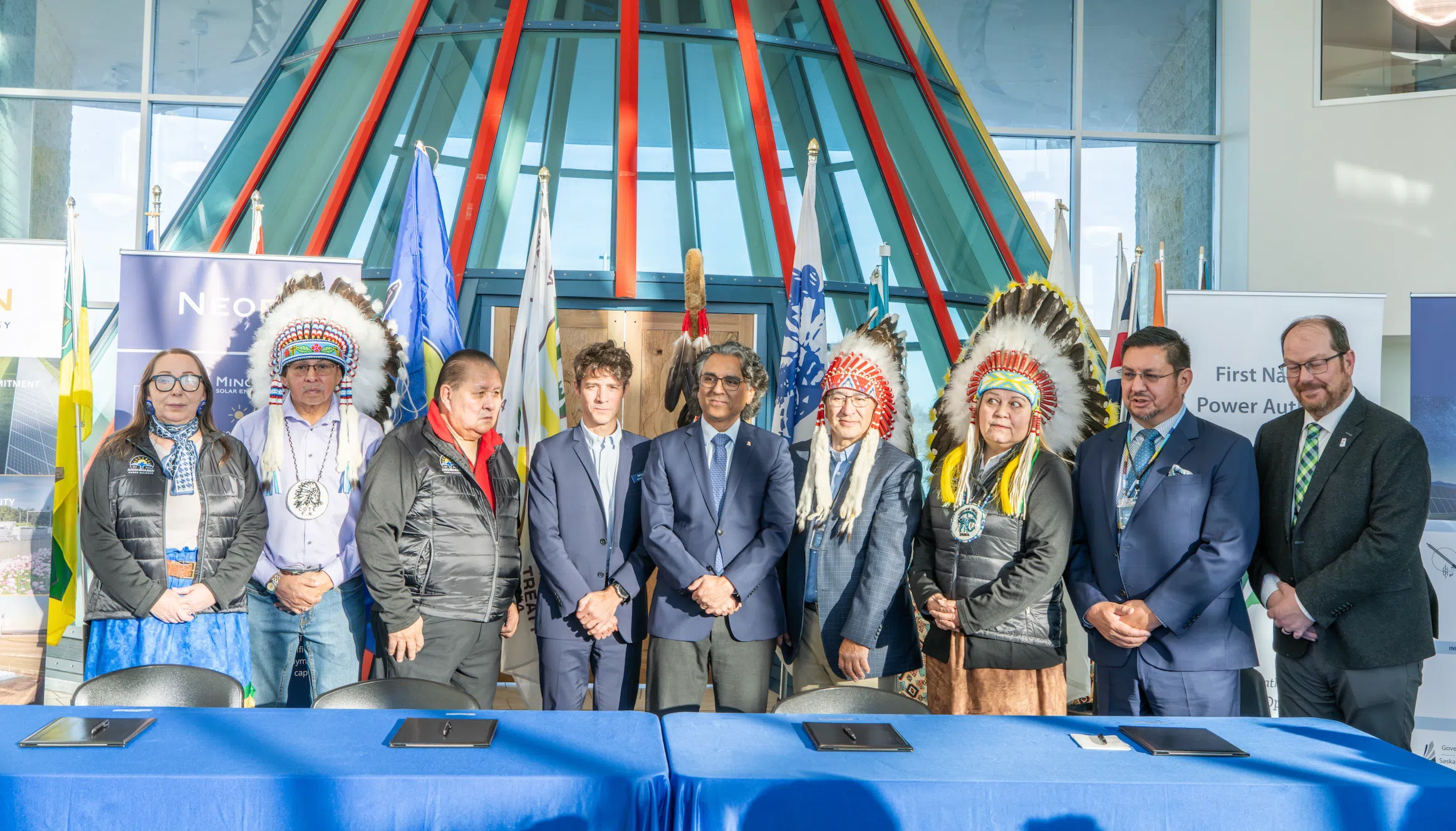
Historic Solar Project to Create Growth for Sask First Nations
-
Share on Facebook
-
Share on Bluesky
-
Share on X
- Copy Link
Significant community and economic impacts are expected from what will be the largest solar energy project of its kind in Saskatchewan.
Last week, French renewable energy corporation Neoen announced the Mino Giizis Energy Facility, a 100-megawatt (MW) solar farm in Lajord, a rural municipality southeast of Regina.
First Nations Power Authority (FNPA) held a competitive procurement process to build, own and operate a 100-MW solar project in south central Saskatchewan. FNPA selected the Mino Giizis project as the top proposal in that competition.
The project is 50-percent owned each by Neoen, and Anishinabek Power Alliance Ltd, which is made up of four First Nations: Cote First Nation, The Key First Nation, Kinistin Saulteaux Nation, and Zagime Anishinabek.
“Indigenous-led developments such as this, in partnership with Neoen, provide a pathway for not only cleaning the grid with more clean energy, but also providing resiliency and affordability to rate payers, while delivering social benefits to First Nation and Indigenous communities,” said Guy Lonechild, President and CEO of FNPA.
Expected to be complete in 2028, the solar facility will generate enough electricity to power 30,000 Saskatchewan homes. But the benefits to Saskatchewan communities is expected in both the near and long-term future.
“Learning about Indigenous culture, we understand there’s a consideration for seven generations into the future,” said Ryan Dick, Neoen Provincial Director for Saskatchewan and Alberta.
“I think that’s a really smart thing to have our businesses looking further into the future and thinking about those future generations.”
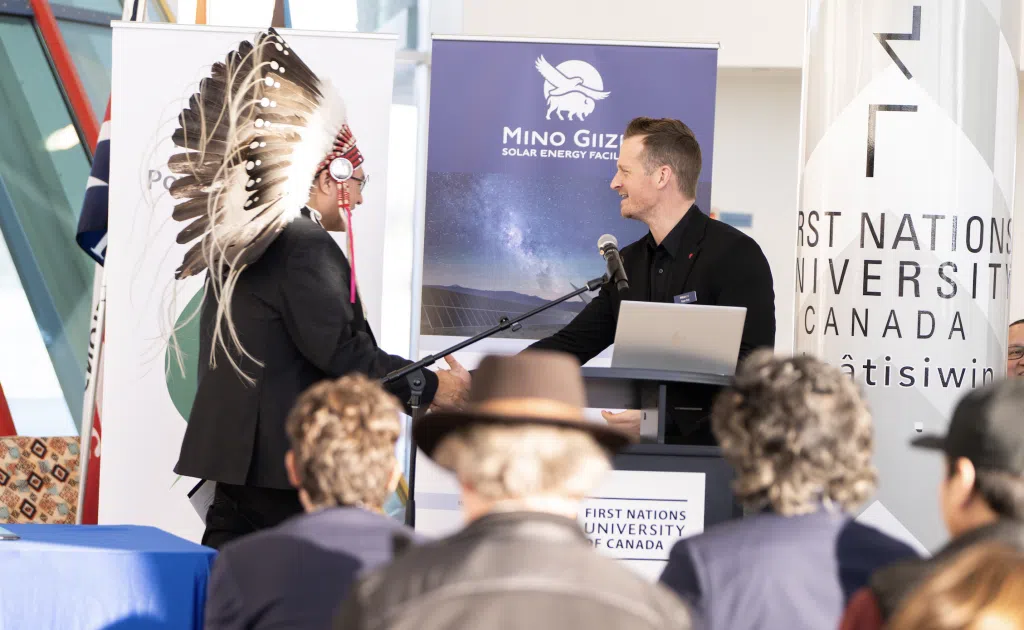
According to Dick, construction of the solar facility could see as much as 350 individuals on site, with a goal of 75 percent Indigenous labour hours.
The First Nations will also receive on ongoing Indigenous benefit payment that compensates them for the project being sited on the traditional land, and can be utilized to make further investments, said Dick.
“(The solar project) is going to pay dividends, and reliable revenue sources for these Nations to have a really good foothold and foundation in economic self-determination,” said Dick.
“It will allow these nations to adopt more clean energy within their communities, and to support more youth who want to work in this growing sector. So it will pay off in a myriad of ways.”
The Mino Giizis Energy Facility also aligns with Indigenous convictions in environmentalism and stewardship, said Lonechild. The project will utilize the province’s solar energy potential, which is the greatest of any province in Canada, at an average yield of approximately 1,330 kWh per 1 kW of installed capacity annually.
“We take a long term approach to living sustainably with Mother Earth, embracing the power of the sun an our spiritual beliefs. It’s growth not just for energy development, but for sustainable agriculture, food security, and energy security,” said Lonechild.
“This is a natural fit for First Nations to want to provide a sustainable and growing future. It’s an exciting time for us, in a way, to be rediscovering our gifts and our perspectives on sustainability.”
Construction for the solar project is expected to start in early 2027.