FNUniv, Riders to Provide Essential Supports to First Year Students
-
Share on Facebook
-
Share on Bluesky
-
Share on X
- Copy Link
Moving from a rural community in Saskatchewan to an urban centre for school can be intimidating for many first-year students. The Saskatchewan Roughriders are making moves to help ease that transition.
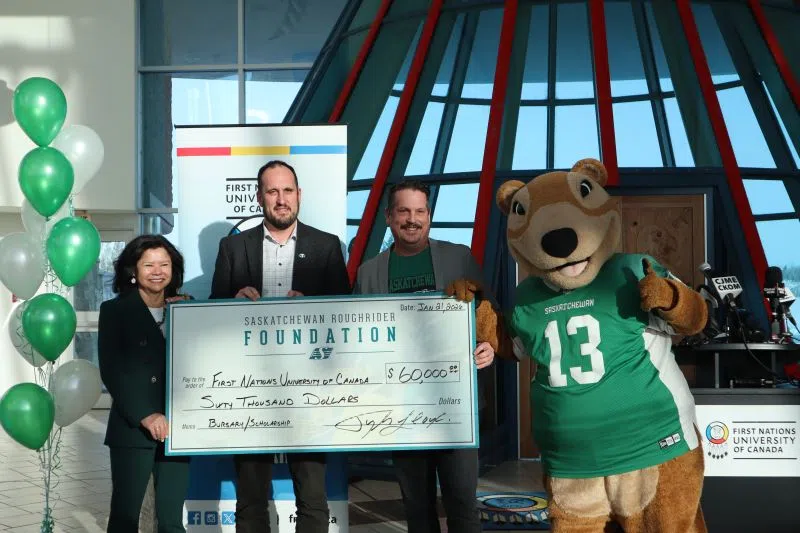
The Saskatchewan Roughriders and the First Nations University of Canada (FNUniv) have announced a $60,000 investment into Indigenous students. The one-time investment includes two awards designed to reduce barriers and recognize academic achievement for students entering FNUniv.
The ‘Away from Home’ bursary, a donation of $40,000, to support students who relocate from a rural area to attend FNUniv. And a $20,000 Saskatchewan Roughrider Foundation Scholarship, for new students entering FNUniv.
“We hear those concerns about financial pressures. We see this as a barrier to attend university. We have heard student that have opted out of attending because of financial pressures with relocating,” Jacqueline Ottmann, FNUniv President told Eagle Feather News.
“So what we are here to do is provide holistic supports for our students to help eliminate those financial barriers.”
Funding from the Away from Home bursary could help students cover travel, accommodation, child care, and other various expenses related to relocation. Ottmann said they have yet to determine the amount given for each individual bursary.
This funding resonates with Ottmann in a deeply personal way, she said. In the 1980s, Ottmann herself moved from the small eastern-Saskatchewan community of Fishing Lake First Nation to Saskatoon to attend the University of Saskatchewan.
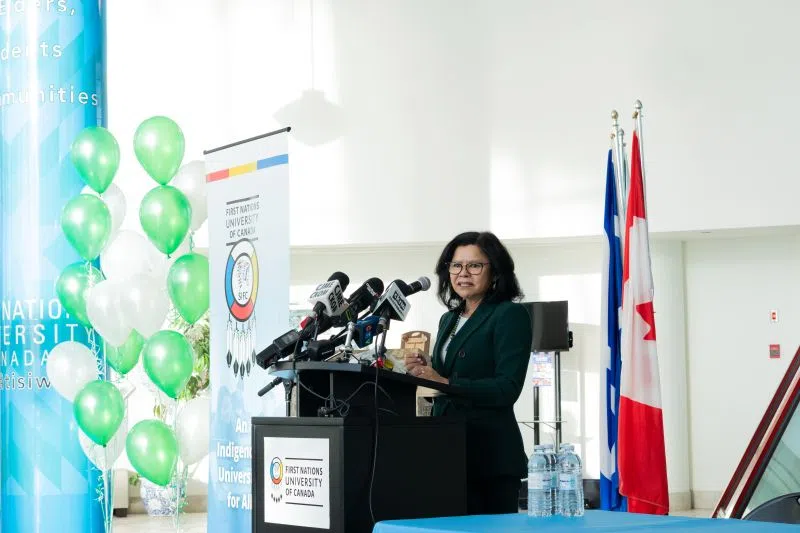
“It was overwhelming. There was culture shock. I never lived in, or rarely visited, a city. I came directly from a small-town high school to this massive university where there were very few Indigenous people, so that first year was challenging,” she said.
Ottmann had financial support from her First Nation, but said it was not enough to cover her living expenses. She said other factors, some of which are less perceptible, can weigh on first-year students from remote areas.
“In rural and remote First Nations communities, everyone knows everyone and there’s a strong sense of community. When you come to the city, there’s a lot more anonymity. A lot of students experience loneliness,” said Ottmann.
“And in the North, you’re living in a specific ecosystem with beautiful lakes and forests. If they come to Regina, they’re moving to a city, to the prairies, and living in a veery different ecosystem,” she said. “A lot of students can’t afford to visit home during the school year.”
Funding for the bursary and scholarship was made possible through the merchandise sales from the Saskatchewan Roughriders Indigenous logo, designed by Chris Chipak of Red Pheasant Cree Nation. Chipak designed the logo in 2024, and colour was added in 2025.